How To Price Your Fine Art Reproductions (Prints)
So you decide to sell prints to supplement your art career. If you’ve already made a work of art and sold it, why not continue to support yourself using the same imagery? Enter: prints. AKA, fine art reproductions.
Pricing prints can be confusing though. Many artists either price too low because they fear no one will buy, or too high without understanding the real economics behind print sales. The result is frustration, thin margins, and a print program that never becomes a meaningful revenue stream.
Successful print pricing is not guesswork. Your prices should factor in production costs, market positioning, and perceived value.
Below is a practical framework that you can use to price prints sustainably.
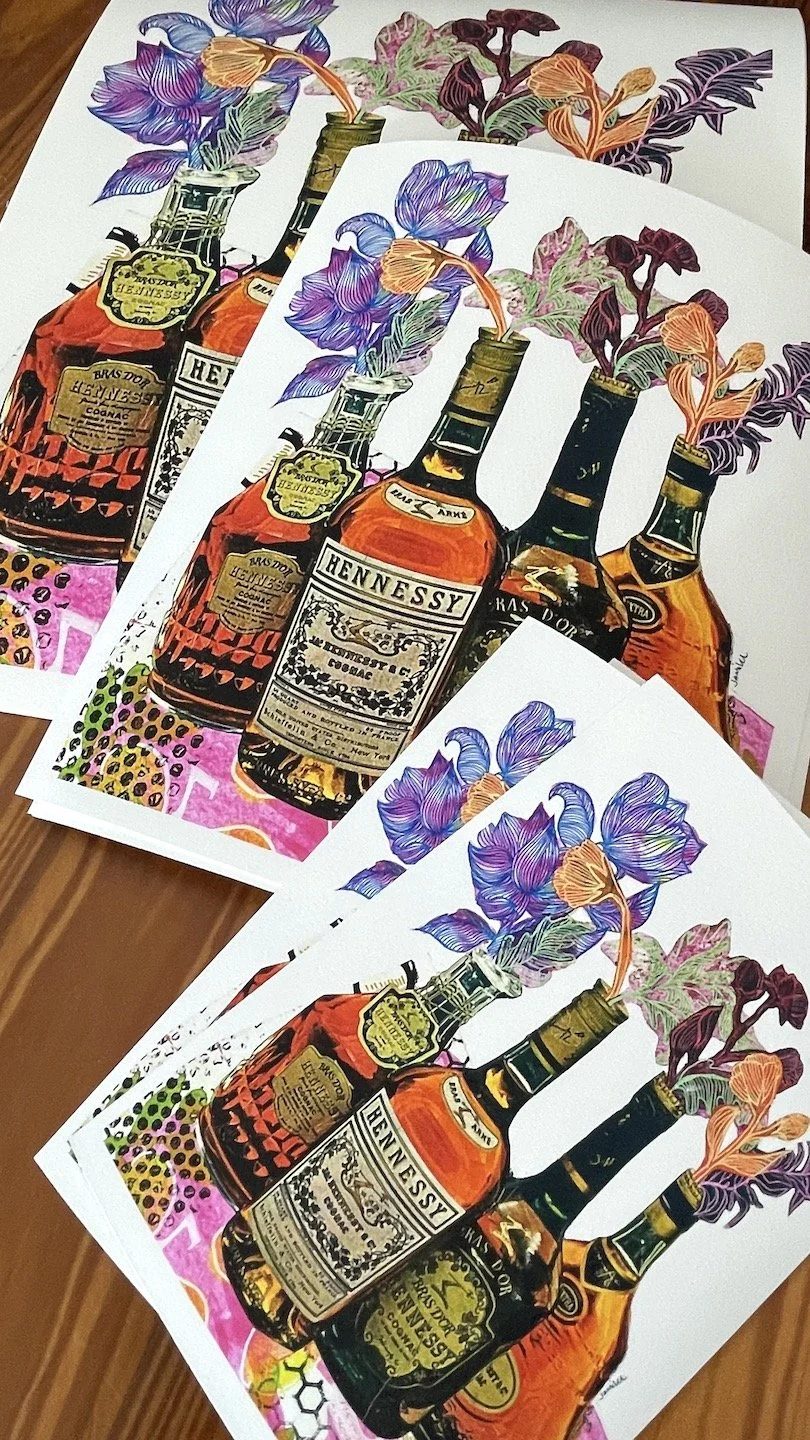
Step 1: Start With Your Real Production Cost
Before you can price your prints, you need to understand what it actually costs to produce each print.
Consider:
Cost per print
Paper + Ink if you are printing from home
Cost per print ordered if you are outsourcing [link to https://www.amazingartprinting.com/]
Packing material - glassine and craft paper or backing board and clear bags
Swag - business cards, stickers, ribbon, any branding that makes your prints stand out
Shipping material - rigid mailers, tubes
For example:
Expense Cost
Printing $8
Packaging $3
Swag $0.75
Total cost $12
Always round up to account for proofing and waste. It’s inevitable!
If you want to get really specific, you could include a percentage of your monthly web subscriptions that fuel your print business, like Shopify, Etsy, Adobe suite, ShipStation, credit card fees, etc, but I recommend you not get too caught up in the granular details. These are all inevitable costs of doing business and should be accounted for in the grand scheme.
Step 2: Use a Minimum 3–5x Markup
A healthy pricing model for art prints is typically 3–5 times your production cost to cover your business overhead and leave room for promotions or wholesale opportunities. It also compensates you for creating the artwork in the first place!
Using the earlier example:
Cost 3x Price 5x Price
$12 $36 $60
A reasonable retail price for that print would fall between $35 and $60.
If you ever want to sell prints through galleries or retailers, this margin becomes essential.
Step 3: Consider the Size and Format
Print pricing scales primarily with size, but not in a purely linear way. Smaller prints make your art more accessible to more collectors, while larger prints are expected to cost more.
For example:
Size Typical Price Range
8 x 10” $35 - $75
11 x 14” $55 - $95
16 x 20” $85 - $325
24 x 36” $295–$750
There are many reasons people buy prints. Prints are an excellent way for people to enjoy your work at a lower price than an original, or as an entry point to collecting your artwork, but they are also great alternatives if an original is sold or no longer available, or a different size would work better in their space. They can become THE thing that collectors seek.
The larger the print, the more it moves from an impulse purchase into a collector purchase.
Step 4: Price According to Your Market Position
Pricing also communicates who your work is for.
Low pricing signals:
Hobby or decor art
Casual buyers
High volume
Higher pricing signals:
Collectible work
Serious collectors
Limited supply
It’s common for Artists to shy away from pricing higher, but underpricing can actually reduce trust in the work. Collectors expect art to be priced like art. Get okay with the idea that some people will think your work is too expensive - it’s not for them.
Step 5: Limited Editions vs Open Editions
Open edition prints are the most common route nowadays with the unlimited reproducibility of giclées. That said, creating limited editions can be a great marketing tactic to drive up pricing and demand. Limited editions often sell for 2 to 4 times the price of open editions. Learn more about limited vs. open edition prints in this article.
Step 6: Leave Room for Growth
Your print prices should be able to grow with your career. Avoid pricing so low that raising prices later feels impossible.
Start slightly conservative and assess your prices annually to determine if an increase is warranted. Feel free to revisit this article periodically to remind yourself of the factors that go into pricing.
In sum, a well-oiled print program can become one of the most profitable and stable income streams for artists. When priced correctly, prints allow your work to reach a wider audience while still honoring the value of the original art.
Final Considerations
It’s best practice to wait until the original has sold before you offer prints. Never sell reproductions of commissioned artwork without express permission from the original buyer, and even then, try to avoid this scenario. The commissioning collector wanted something unique and paid a premium for it, so try to honor that wish.
Nothing damages trust faster than inconsistent pricing. Your prints should cost the same on your website as they do in galleries, at art fairs, through retailers, etc. Consistency builds credibility and protects collectors who bought early.
If you include matting and/or framing, be sure to factor that into your pricing. A matted print presents your work in a more elevated manner, and helps the collector to visualize the work better in a frame. Be sure to charge for your time as well as the matte itself, plus a little extra for the value of the presentation.
TL;DR? A Simple Print Pricing Formula
If you want a quick starting point, use this formula:
Print Price = (Production Cost × 4) + Artistic Value
Example:
Production cost: $18. Base price: $72
You might round this to $75 or $80 depending on size and market positioning.